
Explaining the Best Paver Options for Sloped Yards in Gainesville, GA
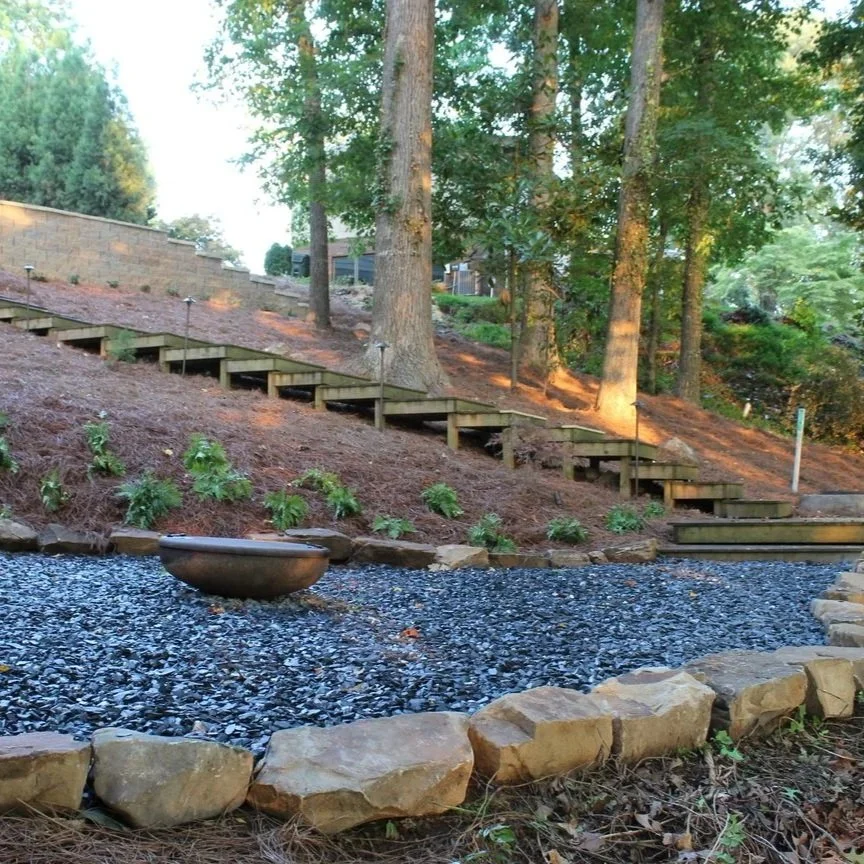
Expertly installed pavers on a Gainesville sloped yard ensure stability, proper drainage, and long-lasting performance.
Understanding Why Sloped Yards Require Different Paver Strategies
Sloped yards introduce challenges that flat installations never face, and in Gainesville, Georgia, those challenges intensify due to clay-heavy soil and frequent rainfall. Gravity constantly works against paver systems on inclines, pulling materials downhill and testing the stability of every layer beneath the surface. A sloped yard demands more than aesthetic planning. It requires a structural mindset that considers soil movement, water flow, and long-term wear patterns that only become obvious years after installation. Homeowners often underestimate how much force a slope applies to pavers over time, especially during heavy rain when saturated soil loses resistance.
Experienced installers approach sloped yards as engineered systems rather than decorative surfaces. Choices related to paver type, base depth, edge containment, and layout all work together to counteract downhill movement. Without that coordination, even high-quality pavers fail prematurely, leading to shifting, gaps, and uneven surfaces that feel unstable underfoot. Understanding why slopes behave differently helps homeowners appreciate why certain paver options perform better in Gainesville’s terrain and climate, and why shortcuts almost always surface later as costly repairs rather than immediate visual flaws.
Evaluating Segmental Concrete Pavers for Inclines
Segmental concrete pavers remain one of the most reliable options for sloped yards when installed correctly. Their uniform shape and interlocking design allow individual units to resist movement by transferring load across the surface rather than concentrating stress in one area. In Gainesville, where slopes often combine gradual grades with sudden elevation changes, segmental pavers adapt well to irregular terrain without sacrificing stability. Their modular nature allows installers to follow contours precisely, reducing voids beneath the surface that can weaken support over time.
Performance on slopes depends heavily on proper base preparation and joint stabilization. Concrete pavers work best when paired with deeper base layers and joint materials designed to harden after compaction. Installers with experience understand how these systems behave during heavy rain events, when water pressure tries to displace both pavers and underlying aggregate. Segmental systems excel because movement in one area spreads across the surface rather than creating isolated failures. That behavior makes them a practical choice for Gainesville homeowners seeking durability on challenging grades rather than decorative appeal alone.
Considering Natural Stone Pavers on Sloped Terrain
Natural stone pavers bring a distinctive aesthetic that appeals to many homeowners, but slopes introduce additional considerations. Stone varies in thickness, texture, and density, which affects how it performs under gravitational stress. In sloped yards, uneven thickness can create inconsistent contact with the base, increasing the risk of movement if installation tolerances are not carefully managed. Gainesville’s freeze-thaw cycles, while less frequent than northern climates, still affect stone differently depending on porosity and moisture absorption.
Installers experienced with stone on slopes take extra care with base leveling, stone selection, and edge restraint reinforcement. Certain stones offer better traction, which improves safety on inclines, especially during wet conditions. Others require surface treatments or texturing to reduce slip risk. Stone performs best when installers understand how each piece interacts with adjacent units rather than treating the surface as a uniform plane. When stone installations succeed on slopes, they reflect deliberate planning rather than material choice alone, particularly in environments like Gainesville, where moisture and soil movement amplify small installation errors.
Understanding the Role of Permeable Pavers on Slopes
Permeable pavers often attract attention for drainage benefits, but sloped yards complicate their performance. While permeability helps manage surface runoff, gravity accelerates water movement through joints, which can erode base materials if not properly designed. In Gainesville, where intense rainfall events occur, permeable systems on slopes require specialized base layers that balance infiltration with structural stability. Without those considerations, permeable installations risk undermining themselves from within.
Installers who understand permeable systems recognize when slopes exceed practical limits for infiltration-based designs. In moderate grades, permeable pavers paired with reinforced bases and controlled drainage paths perform well by reducing surface runoff while maintaining stability. On steeper inclines, installers often integrate hybrid solutions that direct excess water away from the system. Permeable pavers work best when slope angle, soil conditions, and rainfall patterns align with system capabilities rather than being treated as a universal solution for drainage challenges.
Retaining Walls as Structural Partners to Paver Systems
Sloped yards frequently require retaining walls to create stable terraces that support paver installations. These walls function as load-bearing structures rather than decorative borders, resisting soil pressure that would otherwise compromise the surface. In Gainesville, retaining walls often address both elevation changes and drainage control, making them integral to long-term paver performance. Properly designed walls reduce slope angle, allowing pavers to behave more like flat installations without sacrificing usability.
The relationship between retaining walls and pavers depends on coordinated engineering. Walls require proper footings, drainage behind the structure, and alignment with paver base layers. Installers who treat walls as separate projects often create weak transition points where movement concentrates. Integrated design distributes forces evenly across the system. Homeowners benefit when installers explain how walls and pavers work together to stabilize slopes rather than presenting walls as optional upgrades disconnected from surface performance.
Pattern Selection and Its Impact on Slope Stability
Pattern choice influences how well pavers resist downhill movement on slopes. Certain layouts provide greater interlock, distributing force across multiple directions rather than allowing linear movement. In Gainesville, herringbone-style patterns perform particularly well on driveways and walkways built on grades because they resist shear forces created by foot traffic and vehicles. Patterns aligned parallel to slope direction tend to shift more easily over time, especially when joint materials degrade.
Installers experienced with sloped installations select patterns based on function rather than appearance alone. They understand how pattern orientation affects stress distribution under real-world use. Homeowners may gravitate toward simpler designs, but professional guidance often steers pattern choices toward options that extend surface life. Pattern selection becomes a structural decision rather than a decorative one, particularly on slopes where gravity continuously tests surface cohesion.
Base Depth and Material Adjustments for Sloped Yards
Base preparation for sloped yards requires greater depth and compaction than flat installations. In Gainesville’s clay soil, deeper bases provide resistance against saturation-related movement that commonly occurs during prolonged rain. Sloped installations demand layered compaction that locks aggregate in place, preventing downhill migration under load. Skimping on base depth almost always leads to settlement and surface distortion that worsens over time.
Installers with slope experience adjust base composition to match grade severity. They may incorporate angular aggregates that resist movement better than rounded materials. Each layer must interlock with the next, creating friction that counters gravity. Homeowners rarely see these layers once installation finishes, but their performance dictates how the surface behaves years later. Base preparation becomes the silent partner that determines whether pavers remain aligned or slowly drift downhill with seasonal changes.
Edge Restraints and Anchoring Methods for Sloped Installations
Edge restraints play a far more critical role in sloped yards than on flat ground. On an incline, edge systems function as anchors that prevent the entire paver field from creeping downhill over time. In Gainesville, Georgia, where heavy rain saturates soil and reduces friction, gravity constantly tests the weakest point of the installation. Without reinforced edge restraints at the base and sides of a slope, even well-compacted pavers gradually migrate, opening joints and creating uneven transitions. Reliable installations treat edge restraint design as a structural requirement rather than a finishing detail.
Installers experienced with sloped yards often use heavier-duty restraints, deeper anchoring, or concrete-backed edges to counteract downhill force. These systems lock the pavers into place and transfer stress into the base and surrounding soil rather than allowing surface movement. Edge placement must align with slope direction and anticipated water flow, since runoff can undermine poorly supported edges. Homeowners rarely notice edge systems once installation finishes, but their presence determines whether the surface maintains alignment years later. On slopes, edge restraints quietly carry more responsibility than any visible paver choice.
Managing Water Flow Across Sloped Paver Surfaces
Water management becomes more complex on sloped yards because gravity accelerates runoff, increasing erosion risk beneath the surface. In Gainesville, intense rain events can send large volumes of water across paver installations in short periods. Poorly managed flow strips joint material, destabilizes base layers, and concentrates stress at transition points. Effective paver systems on slopes integrate controlled drainage paths that guide water safely off the surface without disrupting structural layers.
Installers skilled in slope work evaluate how water enters and exits the paver field rather than focusing solely on surface slope. They incorporate subtle transitions, drainage channels, or collection points that prevent water from gaining destructive momentum. Proper water management reduces maintenance demands and preserves surface stability. Homeowners often associate drainage only with pooling, but on slopes, erosion presents the greater threat. Installations that handle water predictably age more gracefully and avoid the progressive failures common on poorly planned inclines.
Traction, Safety, and Surface Texture Considerations
Safety becomes a primary concern when selecting pavers for sloped yards, especially in Gainesville’s humid climate, where surfaces remain damp longer after rain. Smooth pavers that perform well on patios may become slippery hazards on inclines. Texture, finish, and joint spacing all influence traction underfoot. Homeowners sometimes prioritize appearance without considering how surfaces feel during daily use, particularly on walkways connecting elevation changes.
Installers with experience guide material selection toward finishes that provide grip without sacrificing comfort. Textured concrete, tumbled stone, and pavers with chamfered edges offer better traction on slopes. Joint materials also affect footing, especially when stabilized sands resist washout. Safety considerations extend beyond immediate usability to long-term wear patterns, as smoother surfaces become slicker over time. Selecting pavers for sloped yards requires balancing aesthetics with functional safety that remains reliable throughout seasonal changes.
Long-Term Maintenance Realities for Sloped Paver Systems
Maintenance demands increase on sloped paver installations because gravity and water accelerate wear. Joint sand displacement, minor shifting, and surface debris movement occur more frequently on inclines. Gainesville homeowners benefit when installers discuss these realities openly rather than portraying sloped installations as maintenance-free. Understanding expected upkeep helps homeowners plan inspections and minor adjustments before small issues escalate.
Installers who build for slopes often design systems that simplify maintenance by reinforcing vulnerable areas and selecting materials that tolerate movement without failure. Routine attention focuses on joint stabilization and drainage checks rather than structural repairs when installations perform as intended. Sloped systems that receive periodic care maintain appearance and functionality far longer than those left unattended. Long-term success depends on acknowledging how slopes influence wear rather than assuming flat-ground performance translates directly.
Balancing Aesthetics With Structural Performance
Sloped yards often inspire creative designs that emphasize visual flow across elevation changes. While aesthetics matter, structural performance must guide design decisions to avoid sacrificing longevity. In Gainesville, where slopes intersect with drainage concerns, visual choices must align with technical realities. Installers who understand slope dynamics help homeowners achieve attractive designs without compromising stability.
Design elements such as borders, steps, and transitions serve both visual and structural purposes. Properly integrated features break up slopes into manageable segments that reduce stress on any single area. Homeowners benefit when design discussions include explanations of how visual elements contribute to performance. Successful sloped paver installations reflect harmony between form and function rather than prioritizing one at the expense of the other.
Understanding When Alternative Solutions Outperform Pavers
Not every slope benefits from full paver coverage. In some Gainesville yards, combining pavers with groundcover, steps, or terraces creates more stable and cost-effective solutions. Installers experienced with sloped properties recognize when pavers should anchor specific functional areas rather than blanket the entire incline. Strategic placement reduces stress on the system while enhancing usability.
Alternative solutions still rely on pavers as structural components, particularly at transitions and landings. Understanding where pavers perform best helps homeowners allocate investment wisely. Installers who discuss alternatives demonstrate confidence rooted in experience rather than a one-size-fits-all approach. Sloped yards reward thoughtful planning that respects terrain rather than forcing uniform solutions onto complex landscapes.
FAQs
Segmental concrete pavers with reinforced bases and strong edge restraints perform best. Their interlocking design distributes weight and resists downward pressure more effectively than natural stone or irregular materials.
Permeable pavers can work well on moderate slopes when installed with reinforced base layers and proper drainage. However, steeper slopes may require hybrid systems to prevent internal erosion and shifting.
Yes. Because of gravity and water flow, slopes may experience increased joint sand loss and minor shifting. Occasional refilling, leveling, and inspection help maintain long-term performance.
Gentle slopes may not need retaining walls, but steeper slopes typically benefit from terracing or retaining structures. These features reduce downward pressure and extend the lifespan of the installation.
Clay-heavy soil in Gainesville expands and contracts with moisture. On slopes, this movement increases the risk of shifting. A deeper base, proper compaction, and effective drainage help counteract soil movement.
